
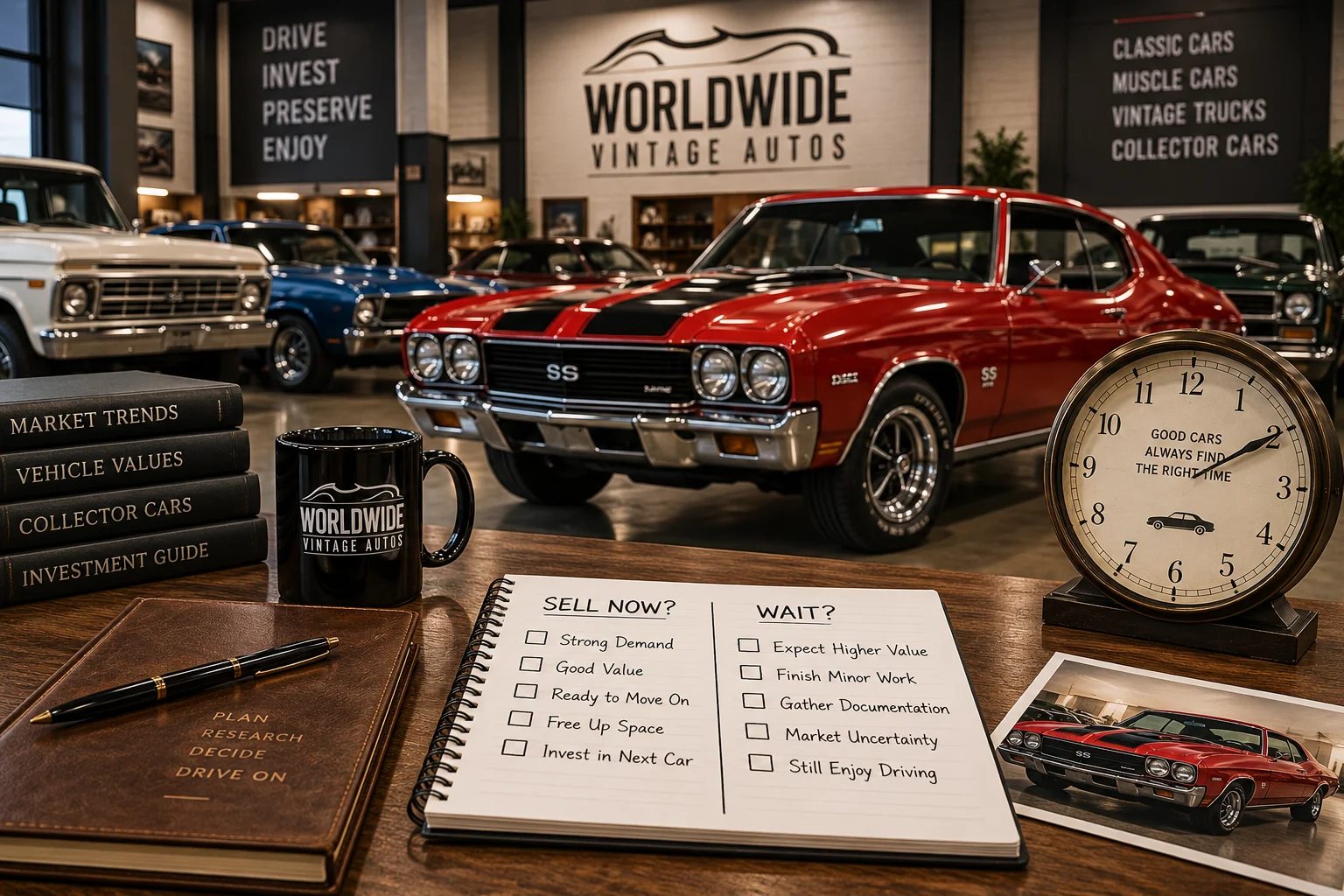
How to decide when to sell a classic car based on market demand, vehicle condition, ownership costs, seasonality, and your personal goals.
If you're asking "Should I sell my classic car now or wait?", there isn't one answer that applies to every vehicle. The right time to sell depends on the specific car, its condition and desirability, current buyer demand, your ownership costs, and whether waiting is likely to improve - or hurt - your position.
For many owners, the better question isn't simply whether the overall classic car market is up or down. It's whether your specific vehicle is ready to sell and there are qualified buyers looking for cars like it.
A desirable, properly presented classic with good documentation can attract buyers in many market conditions. Waiting can make sense when the vehicle needs minor preparation, documentation is incomplete, or you simply aren't ready to sell. But holding a car solely because you expect its value to rise can introduce additional storage, maintenance, insurance, and market risk.
Here's how to evaluate the decision.
Quick Answer: Is Now a Good Time to Sell My Classic Car?
It may be a good time to sell your classic car when:
- There is established demand for your make and model
- The vehicle is in strong, marketable condition
- You have documentation ready
- You no longer drive or enjoy the vehicle regularly
- Storage and maintenance costs are increasing
- You're comfortable with its current estimated market value
- You have a clear reason for selling
Waiting may make more sense when the car needs straightforward maintenance, important records still need to be organized, or you haven't yet established a realistic idea of what the vehicle may be worth.
Trying to perfectly time the collector-car market, however, is difficult. Vehicle-specific factors often matter more than choosing the perfect month to sell.
What Determines the Best Time to Sell a Classic Car?
Classic car values don't move uniformly.
A 1960s muscle car, vintage pickup, European sports car, and 1980s collector vehicle may experience completely different levels of buyer demand at the same time.
Before deciding whether to sell now or wait, evaluate six major factors:
- Current market value
- Demand for your specific vehicle
- Vehicle condition
- Seasonality
- Cost of continuing ownership
- Your personal reason for selling
Together, these factors provide a more useful framework than trying to predict the entire collector-car market.
1. Start by Understanding What Your Classic Car Is Worth
Before deciding when to sell a classic car, determine what it may realistically be worth today.
Classic car valuation depends on factors including:
- Year, make, and model
- Trim and configuration
- Engine and transmission
- Condition
- Originality
- Matching-numbers status
- Restoration quality
- Documentation
- Modifications
- Collector demand
Two vehicles from the same year can have dramatically different values.
For example, differences in engine configuration, originality, restoration quality, or documentation can significantly affect how buyers evaluate otherwise similar cars.
That's why your first step should be establishing a realistic market range for your specific vehicle.
Internal link opportunity: What's My Classic Car Worth? A Complete Classic Car Valuation Guide
2. Look at Actual Buyer Demand, Not Just Asking Prices
One of the easiest mistakes to make when deciding whether to sell is searching online listings and assuming those asking prices represent current market value.
They don't necessarily.
There is an important difference between:
What sellers are asking
and
What buyers are willing to pay.
A vehicle can remain listed at an ambitious price for months without selling.
When evaluating the market, focus on genuinely comparable vehicles and, where available, completed transactions.
Compare vehicles with similar:
- Model years
- Engines
- Transmissions
- Condition
- Restoration quality
- Originality
- Equipment
The more closely a comparable vehicle resembles yours, the more useful it becomes.
3. Is Demand Strong for Your Specific Classic?
The classic car market isn't one single market.
Different segments attract different buyers.
Demand can vary among:
- American muscle cars
- Vintage trucks
- Corvettes
- Mustangs
- Camaros
- Broncos
- Restomods
- Original survivors
- European classics
- Modern collectibles
A broad headline about classic-car values doesn't necessarily tell you what is happening with your vehicle.
Instead, ask:
Are buyers currently looking for cars like mine?
If comparable vehicles are selling and buyer interest is healthy, waiting for a theoretical future price increase may not always be necessary.
4. Consider the Condition of Your Classic Car
Condition affects both value and how easily a vehicle may sell.
Ask yourself:
- Does the car run and drive properly?
- Is there significant rust?
- Does it need obvious mechanical work?
- Is the paint presentable?
- Is the interior complete?
- Are there unresolved electrical problems?
- Is the vehicle ready for someone else to enjoy?
A well-maintained classic can be easier to market because buyers have fewer immediate concerns.
However, that doesn't mean you should automatically restore a car before selling it.
Should I Restore My Classic Car Before Selling?
Usually, this decision should be based on economics rather than emotion.
A major restoration can require significant money and time, and the amount invested does not automatically translate into an equal increase in market value.
For example, spending heavily on:
- Paint
- Bodywork
- Engine rebuilding
- Interior restoration
- Chrome
- Suspension
may improve the vehicle considerably without increasing its selling price by the same amount.
Before beginning major work specifically to sell, compare:
Current estimated value + restoration cost + time required
against:
Likely market value after restoration
In some cases, selling the vehicle in its current condition may make more financial sense.
What Should I Fix Before Selling a Classic Car?
Major restoration is one thing. Basic preparation is another.
Straightforward improvements may make a classic easier for buyers to evaluate.
Consider:
- Cleaning and detailing the vehicle
- Addressing basic maintenance
- Checking fluid levels
- Making sure the battery is healthy
- Correcting minor operational issues
- Organizing documentation
- Locating spare keys
- Gathering parts included with the sale
The goal isn't to hide imperfections.
It's to present the vehicle accurately and professionally.
5. Does Seasonality Matter When Selling a Classic Car?
Seasonality can influence buyer behavior, but it shouldn't necessarily determine your entire selling strategy.
Enthusiast activity can increase around:
- Spring driving season
- Summer car shows
- Major automotive events
- Collector-car auctions
Warmer weather can also make inspections, transportation, and recreational driving easier in many regions.
However, online classic-car shopping has made the market increasingly national.
A buyer in Arizona, Texas, Florida, or California may be actively shopping while a seller elsewhere is storing a vehicle for winter.
So while seasonality can affect demand, the quality, desirability, presentation, and price of the vehicle remain critical throughout the year.
Is Spring the Best Time to Sell a Classic Car?
Spring can be attractive because many enthusiasts begin thinking about driving season.
But there is no guarantee that spring will produce a higher sale price for every classic.
A desirable vehicle with strong presentation and realistic pricing can attract serious buyers outside traditional peak periods.
If your car is ready to sell and there is active demand, waiting several months solely for a particular season may not always provide an advantage.
6. Calculate the Cost of Waiting
Waiting isn't free.
Every additional year of ownership can involve:
- Insurance
- Storage
- Registration
- Maintenance
- Repairs
- Battery replacement
- Tire aging
- Fluid service
There is also the physical effect of storage.
Classic cars generally still require attention even when they're not regularly driven.
If you're keeping a vehicle solely because you hope its price will rise, compare the potential appreciation against the actual cost of continuing to own it.
Example: Why a Higher Future Price Doesn't Always Mean More Profit
Suppose an owner believes a vehicle could be worth more several years from now.
Even if the sale price eventually increases, the owner may have paid additional costs during that period for:
- Storage
- Insurance
- Maintenance
- Repairs
- Registration
There is also no guarantee that market demand will move in the expected direction.
This doesn't mean owners should rush to sell.
It simply means holding a classic car is an investment decision with costs, not a free option to wait for a better market.
7. Think About How Much You Actually Use the Car
Financial considerations aren't the only reason to sell.
Ask yourself:
Am I still enjoying this vehicle?
Maybe the car once represented a dream but now:
- Rarely leaves storage
- Requires more maintenance than you want
- No longer fits your lifestyle
- Competes for garage space
- Belongs to a collection you're downsizing
In those situations, waiting for a hypothetical peak market price may be less important than finding the vehicle a new owner.
Classic cars are meant to be appreciated. Sometimes selling allows both the seller and the next enthusiast to get more value from the vehicle.
8. Consider Whether Your Collection Has Changed
Collector preferences evolve.
Someone who started collecting American muscle cars may later become interested in:
- Vintage trucks
- European sports cars
- Restomods
- Earlier classics
- Modern collectibles
Selling one vehicle can free up capital and space for another.
In that case, the decision isn't necessarily about leaving the classic-car market.
It may simply be about repositioning your collection.
9. Documentation Can Affect When You're Ready to Sell
Before listing a vehicle, gather its records.
Useful documentation may include:
- Title
- Maintenance history
- Restoration invoices
- Restoration photographs
- Build sheet
- Factory paperwork
- Previous ownership records
- Receipts for major components
Good documentation can help potential buyers understand exactly what they're considering.
If you know important records exist but haven't gathered them yet, spending a little time organizing them before selling may be worthwhile.
10. Originality Can Influence Your Selling Strategy
If your classic retains significant original components, make sure you understand what you have before setting a price.
Potentially important characteristics include:
- Original engine
- Original transmission
- Factory paint color
- Original interior
- Factory options
- Matching numbers
- Documented production configuration
These details may influence collector interest.
Before selling an apparently ordinary classic, verify its specifications.
You don't want to discover after the sale that the vehicle had a rare or desirable factory configuration you hadn't properly identified.
Should I Sell My Classic Car if Prices Are Falling?
A softer market doesn't automatically mean you should wait.
The decision depends on:
- Your vehicle
- Your ownership costs
- Your reason for selling
- Current buyer demand
- Your acceptable sale price
Waiting only works in your favor if future market conditions improve enough to offset the cost and risk of continued ownership.
If you already want to sell and can achieve a price that makes sense for you, broader market uncertainty doesn't necessarily mean you should postpone indefinitely.
Should I Sell My Classic Car if Prices Are Rising?
Likewise, rising prices don't automatically mean you should sell immediately.
If you love the car and aren't interested in selling, market appreciation alone doesn't create a reason to part with it.
But if you've already been considering selling, stronger demand may provide a useful opportunity to evaluate your options.
The decision should still start with your individual vehicle and goals.
Is My Classic Car Likely to Increase in Value?
No one can guarantee future appreciation.
Historically desirable collector vehicles may benefit from factors such as:
- Limited supply
- Strong enthusiast communities
- Cultural significance
- Performance heritage
- Attractive styling
- Historical importance
But collector preferences change.
Generational tastes, economic conditions, vehicle supply, restoration trends, and broader consumer behavior can all affect future demand.
Treat future appreciation as a possibility - not a certainty.
When Does Waiting Make Sense?
Waiting may be reasonable when:
- You aren't financially or personally ready to sell
- Important documentation needs to be gathered
- Minor maintenance would materially improve marketability
- You don't yet understand the vehicle's value
- You're still actively enjoying the car
- The vehicle has meaningful sentimental value
Selling shouldn't feel forced simply because the market appears active.
When Might Selling Now Make More Sense?
Selling may deserve serious consideration when:
- You rarely use the vehicle
- Storage has become difficult
- Maintenance costs are increasing
- You're downsizing a collection
- You want to purchase another vehicle
- There is active demand for your model
- You're comfortable with today's market value
- You've already been considering selling
In those situations, waiting purely in hopes of a higher future price introduces uncertainty.
Selling Privately vs. Consigning Your Classic Car
Once you've decided to sell, the next question is how.
Private sales give owners direct control over the process, but they also require you to handle:
- Photography
- Listings
- Marketing
- Buyer inquiries
- Viewings
- Negotiations
- Transaction coordination
Classic car consignment provides another option.
A collector-car specialist can market the vehicle and help manage the sales process according to the consignment agreement.
For owners who want professional assistance and access to an established collector audience, consignment may be worth considering.
How Do I Know if I'm Ready to Sell My Classic Car?
Use this quick checklist.
Your Vehicle
- Do you know its approximate current value?
- Is the car accurately identified?
- Do you understand its condition?
- Have you verified important originality claims?
- Is it reasonably prepared for sale?
Your Documentation
- Do you have the title?
- Have you gathered maintenance records?
- Are restoration records available?
- Do you have factory documentation, if applicable?
Your Goals
- Why do you want to sell?
- What price would make sense to you?
- Are you prepared to let the vehicle go?
- Would you prefer to sell privately or through consignment?
If you can answer those questions confidently, you're probably much closer to being ready to sell than someone simply trying to guess the next market peak.
Frequently Asked Questions About When to Sell a Classic Car
What is the best month to sell a classic car?
There is no universally best month. Spring and summer can bring increased enthusiast activity in many regions, but online marketplaces and nationwide buying mean desirable classics can attract buyers throughout the year.
Should I wait for my classic car to increase in value?
Only if holding the vehicle makes sense for your broader goals. Future appreciation isn't guaranteed, and storage, insurance, maintenance, and repairs should be considered when evaluating the cost of waiting.
How do I know what my classic car is worth before selling?
Evaluate its exact year, make, model, configuration, condition, originality, documentation, and restoration quality, then compare it with genuinely comparable market activity. A collector-car specialist can also help you assess the vehicle.
Should I restore my classic car before selling it?
Not automatically. Major restoration costs may exceed the additional market value created. Calculate the likely return before committing to extensive work solely for resale.
Is it better to sell a classic car privately or on consignment?
Neither is automatically better. Private sales provide more direct control but require more seller involvement. Consignment can reduce the workload by having a specialist handle marketing and buyer communication according to an agreed process.
Does mileage matter when selling a classic car?
It can, particularly for documented low-mileage or highly original vehicles. However, condition, originality, specifications, maintenance, and documentation may be equally or more important depending on the vehicle.
Do classic cars always increase in value?
No. Some collector vehicles appreciate while others remain stable or decline. Market demand changes over time, so appreciation should never be assumed.
The Bottom Line: Should You Sell Your Classic Car Now or Wait?
There is no perfect universal moment to sell a classic car.
If your vehicle is marketable, you understand its approximate value, buyer demand exists, and selling aligns with your personal goals, waiting for the theoretical "perfect market" may not be necessary.
On the other hand, if you still enjoy the vehicle, aren't ready to sell, or need time to properly identify, document, or prepare it, there may be good reasons to wait.
Rather than trying to predict exactly where classic-car prices will go next, focus on the factors you can evaluate today:
What is your car worth? What does it cost to keep? How strong is demand? And what do you want to do with it?
Those answers can tell you far more than attempting to perfectly time the market.
Thinking About Selling Your Classic Car?
If you're considering selling but aren't sure whether now is the right time, start by understanding where your vehicle stands in today's collector market.
Worldwide Vintage Autos works with classic cars, muscle cars, vintage trucks, and other collector vehicles and can help owners explore their selling options.
Contact Worldwide Vintage Autos to discuss your vehicle, its current market position, and whether consignment may be the right next step.
Thinking about buying or selling a classic?
Our team works with collectors worldwide. Reach out and we will help you with the next step.