
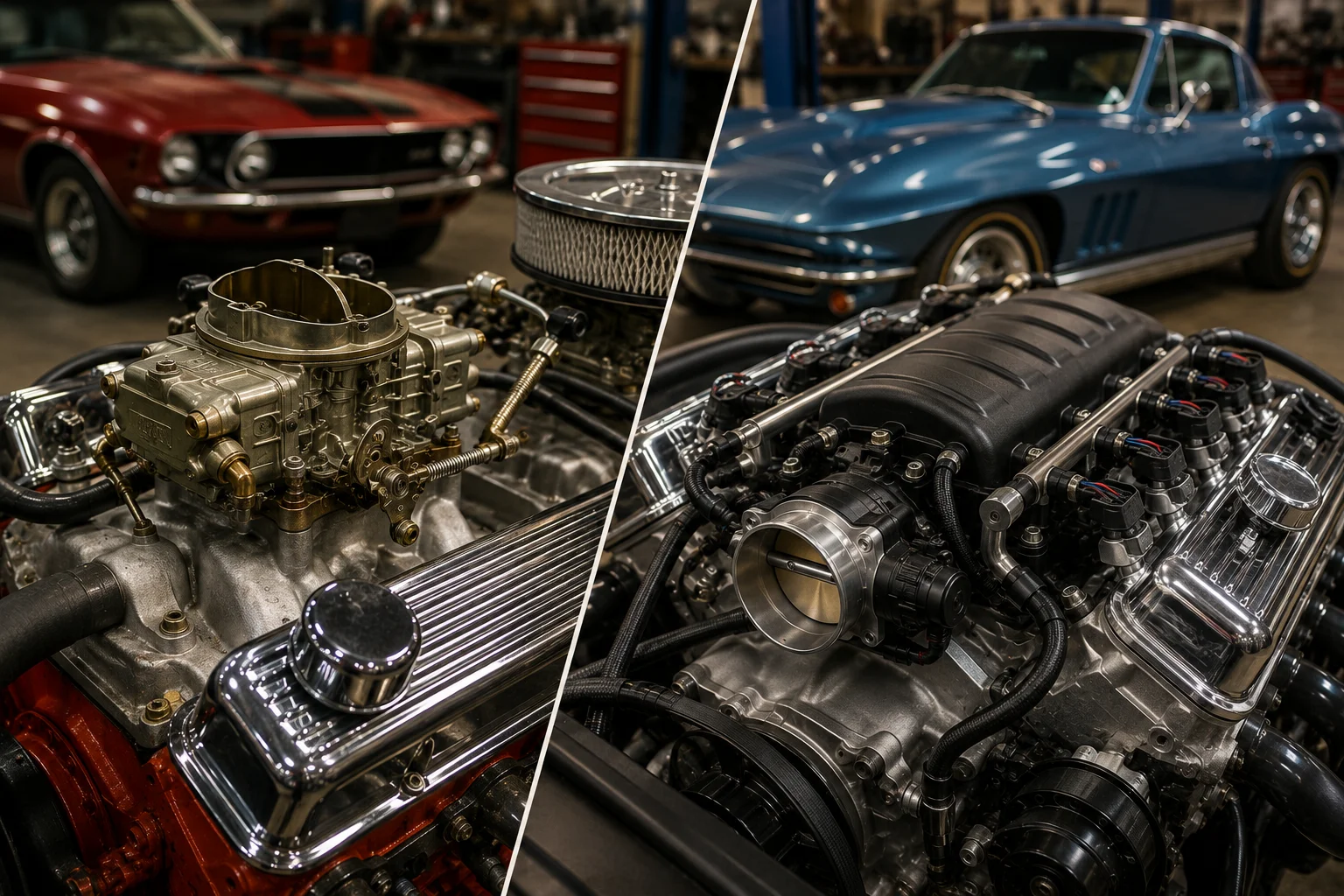
Understanding the Pros, Cons, and Best Choice for Your Classic Vehicle
For classic car enthusiasts, few debates generate more discussion than carburetor vs fuel injection. Purists often appreciate the simplicity and authenticity of carburetors, while others embrace the reliability and performance benefits that modern fuel injection systems provide.
If you're restoring a classic car, upgrading a collector vehicle, or simply trying to understand the differences between these two fuel delivery systems, choosing the right setup can significantly impact your vehicle's performance, drivability, maintenance requirements, and value.
So which is better? The answer depends on your goals.
Let's take a closer look at how carburetors and fuel injection systems work, their advantages and disadvantages, and which option may be best for your classic car.
Understanding Fuel Delivery Systems
Every internal combustion engine requires the proper mixture of air and fuel to operate efficiently.
The job of both carburetors and fuel injection systems is to deliver that mixture to the engine.
The difference lies in how they accomplish that task.
What Is a Carburetor?
Carburetors were the standard fuel delivery system for most vehicles built before the late 1980s.
A carburetor uses airflow and vacuum pressure to mix fuel and air before sending it into the engine.
This entirely mechanical system became a cornerstone of automotive engineering for decades.
Classic vehicles equipped with carburetors include many iconic models such as:
- Chevrolet Camaro
- Ford Mustang
- Dodge Charger
- Pontiac GTO
- Chevrolet Corvette
For many enthusiasts, carburetors are an essential part of the classic driving experience.
How Carburetors Work
A carburetor functions by drawing air through a venturi, creating a pressure difference that pulls fuel into the airflow.
The resulting mixture enters the engine cylinders where combustion occurs.
Key components include:
- Float bowl
- Jets
- Venturi
- Throttle plates
- Choke system
Because carburetors are mechanical, adjustments are typically made manually.
What Is Fuel Injection?
Fuel injection delivers fuel directly into the intake manifold or combustion chamber using electronically controlled injectors.
Unlike carburetors, fuel injection systems continuously monitor operating conditions and adjust fuel delivery accordingly.
Modern fuel injection systems rely on sensors that measure:
- Airflow
- Temperature
- Engine load
- Throttle position
- Oxygen levels
This allows fuel injection to optimize performance under a wide variety of driving conditions.
The History of Fuel Injection in Performance Cars
While fuel injection became common during the 1980s and 1990s, the technology actually dates back much earlier.
Chevrolet introduced fuel injection on the Corvette as early as 1957, creating one of the first mass-produced American performance cars equipped with electronic fuel delivery technology.
Today, virtually every modern vehicle uses some form of fuel injection.
Carburetor Advantages
Many enthusiasts continue choosing carburetors despite the rise of fuel injection.
Here are some of the reasons why.
Authenticity
For collectors seeking originality, carburetors preserve the factory-correct configuration of classic vehicles.
Maintaining originality can be especially important for:
- Concours restorations
- Collector vehicles
- Historically significant cars
Authenticity often contributes to collector value.
Simplicity
Carburetors contain fewer electronic components.
Many owners appreciate being able to:
- Tune the system themselves
- Troubleshoot problems manually
- Perform maintenance without specialized diagnostic equipment
For mechanically inclined enthusiasts, simplicity is a major advantage.
Lower Initial Cost
A traditional carburetor setup generally costs less than a complete fuel injection conversion.
Many restoration projects operate under strict budgets, making carburetors an attractive option.
Traditional Driving Experience
Many enthusiasts enjoy the sound, feel, and character of a carbureted engine.
The unique throttle response and engine personality contribute to the nostalgic appeal of classic cars.
Carburetor Disadvantages
Despite their appeal, carburetors have limitations.
Frequent Tuning
Changes in:
- Altitude
- Temperature
- Humidity
can affect carburetor performance.
This often requires periodic adjustments.
Lower Fuel Efficiency
Carburetors typically deliver less precise fuel metering compared to fuel injection.
As a result, fuel consumption is often higher.
Harder Cold Starts
Cold-weather starting can be more challenging with carbureted vehicles.
Improper choke operation frequently causes startup issues.
Reduced Consistency
Carburetors generally cannot adapt to changing driving conditions as effectively as electronic systems.
Performance may vary depending on environmental factors.
Fuel Injection Advantages
Fuel injection offers numerous benefits for drivers seeking improved reliability and performance.
Improved Reliability
One of the biggest advantages of fuel injection is consistent operation.
Fuel injection systems automatically adjust to changing conditions, helping eliminate many common drivability issues.
Better Fuel Efficiency
Precise fuel delivery helps maximize efficiency.
Many classic car owners report noticeable fuel savings after converting from carburetion to fuel injection.
Easier Starting
Fuel-injected vehicles typically start faster and more reliably in:
- Cold weather
- Hot weather
- High altitudes
This improved convenience makes fuel injection attractive for regularly driven classics.
Enhanced Performance
Fuel injection often improves:
- Throttle response
- Idle quality
- Acceleration
- Overall drivability
Many modern systems can also support significant horsepower increases.
Self-Adjusting Operation
Unlike carburetors, fuel injection systems automatically compensate for environmental changes.
This reduces the need for ongoing tuning.
Fuel Injection Disadvantages
Fuel injection isn't perfect.
There are trade-offs to consider.
Higher Upfront Cost
Fuel injection conversion kits can be expensive.
Complete installations may include:
- Electronic control units (ECUs)
- Sensors
- Fuel pumps
- Wiring harnesses
- Injectors
Costs can quickly exceed several thousand dollars.
Increased Complexity
Modern fuel injection systems introduce electronics that may intimidate some classic car owners.
Diagnosing problems often requires specialized knowledge and equipment.
Reduced Originality
For collectors focused on authenticity, converting a factory-carbureted vehicle to fuel injection may reduce historical accuracy.
This can impact value for certain collector-grade vehicles.
Which System Performs Better?
From a pure performance standpoint, fuel injection generally has the advantage.
Benefits include:
- More accurate fuel delivery
- Better throttle response
- Improved engine efficiency
- Greater consistency
However, carburetors remain highly effective when properly tuned.
Many high-performance drag racing and muscle car applications still use carburetors successfully.
The best choice depends on how the vehicle will be used.
Fuel Injection Conversions for Classic Cars
Fuel injection conversion kits have become increasingly popular among classic car owners.
Modern systems often offer:
- Hidden installations
- Factory-style appearance
- Plug-and-play operation
- Smartphone tuning capabilities
These conversions allow owners to enjoy modern drivability while preserving a classic appearance.
Which Option Is Best for Restored Classic Cars?
The answer depends on your restoration goals.
Choose a Carburetor If:
- Originality is important
- You enjoy mechanical tuning
- The vehicle is a show car
- You want an authentic driving experience
Choose Fuel Injection If:
- Reliability is a priority
- You drive the vehicle frequently
- You want better fuel economy
- You prefer modern performance
Many enthusiasts find fuel injection particularly attractive for restomod projects.
Impact on Collector Value
Collector value can vary depending on the vehicle and buyer preferences.
For investment-grade collector cars:
- Factory-original configurations often command premiums.
- Matching-numbers vehicles tend to be most desirable.
For driver-quality classics:
- Fuel injection upgrades may increase appeal due to improved usability.
Understanding your target market is important before making modifications.
The Future of Classic Car Performance
As restoration technology continues evolving, fuel injection systems are becoming more sophisticated and easier to integrate into vintage vehicles.
At the same time, carburetors remain deeply connected to classic car culture and continue attracting enthusiasts who appreciate traditional automotive engineering.
Both systems have earned their place in automotive history.
Final Thoughts
The carburetor vs fuel injection debate ultimately comes down to personal preference and intended vehicle use.
Carburetors offer:
- Authenticity
- Simplicity
- Traditional driving character
Fuel injection provides:
- Reliability
- Efficiency
- Modern drivability
Neither option is universally right or wrong.
The best choice is the one that aligns with your goals for the vehicle, whether that's preserving originality, maximizing performance, or enjoying your classic car on the open road.
Contact a Restoration Expert
Considering a restoration project or evaluating performance upgrades for your classic car?
Worldwide Vintage Autos specializes in restored classics, collector vehicles, and expert guidance for enthusiasts looking to preserve or enhance their investment.
Contact our team today to discuss restoration options, available inventory, and classic car expertise:
Thinking about buying or selling a classic?
Our team works with collectors worldwide. Reach out and we will help you with the next step.